Flywheel Fundamentals
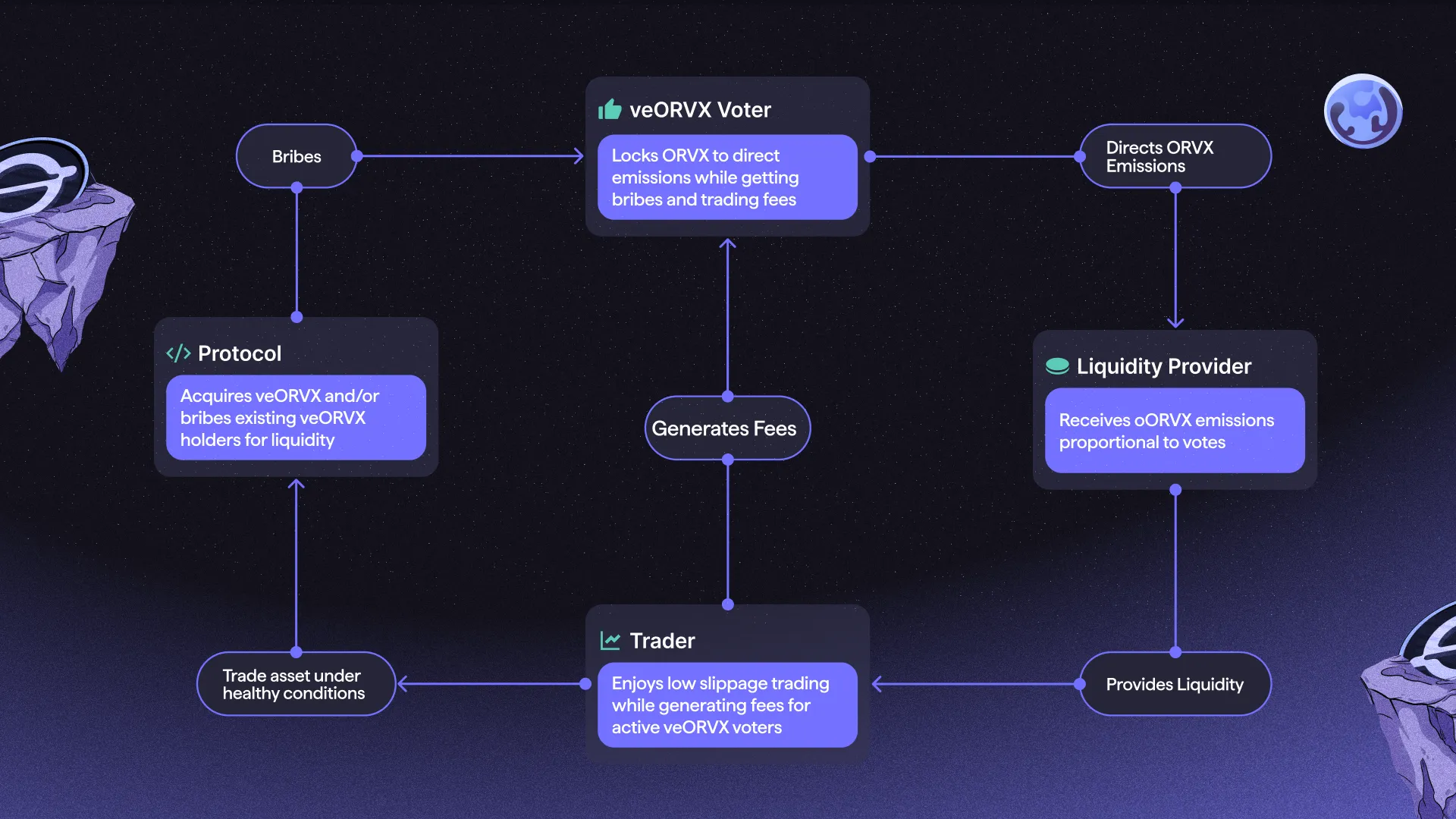
The Orvex ecosystem is built around synergy and balance, combining the efforts of users, protocols and liquidity providers to drive the liquidity strategy on Status. This collaborative design creates positive feedback loops that reinforce platform utility, depth of liquidity and long-term value.
Liquidity Providers
At the core of the DEX, liquidity providers enable seamless trading by supplying capital to concentrated and stable/volatile pools. Concentrated liquidity improves capital efficiency and fee generation compared with traditional constant-product models.
LPs earn oORVX emissions tied to the pools they support, distributed through gauge staking.
Traders
Traders benefit from a deep, competitive trading environment with reduced slippage and better pricing, especially in actively managed ranges. As volume flows through Orvex, fees are generated and redirected back into the system, rewarding the participants who provide and coordinate liquidity.
100% of trading fees are distributed to veORVX voters, linking trading activity directly to governance participants.
Protocols
Protocols can bootstrap and scale liquidity for their tokens by directing emissions towards their key pools and offering external incentives to veORVX voters.
By aligning emissions and incentives with their priority pairs, protocols can:
- Improve APRs on strategic pools
- Attract more LPs
- Build deeper, more reliable liquidity for their communities
This makes protocols an essential driving force within the Orvex flywheel.
veORVX Voting
veORVX voters play a central coordination role. By locking ORVX, they receive veORVX, which gives them:
- Voting power over gauge weights and emissions
- Exposure to trading fees and external incentives directed at the pools they support
Through their choices, veORVX holders effectively route rewards towards the most productive pools, shaping the liquidity landscape over time.
Orvex adopts ve(3,3) mechanics, combining vote-escrowed locking (inspired by Curve) for long-term alignment with game-theoretic incentive design (popularised by OlympusDAO). The result is a system that encourages:
- Long-term ORVX locking
- Consistent liquidity provision
- Active governance participation
All three stakeholder groups — traders, LPs and protocols — feed into the same flywheel, reinforcing Orvex as the liquidity layer for Status.
Karma and the gasless loop
Karma adds a fourth reinforcing loop to the Orvex flywheel. As a native Status Network application, Orvex distributes Karma to LPs and veORVX voters alongside oORVX emissions and voter rewards. This Karma increases each participant's gasless transaction throughput — enabling more trading, more position management, and more governance participation without friction.
Orvex also retains a Karma allocation to influence Status Network governance, directing native yield back toward Orvex LP incentives. The result: active participation in Orvex strengthens your position across both the protocol and the network.
More activity → more Karma → more gasless throughput → more activity. The loop tightens.
Learn more about how Orvex leverages Karma in Karma & Gasless Execution.